Portfolio
Selected research projects · question, method, finding, impact
A selection of research projects framed around what I usually care about most: the question we needed to answer, the methods I chose and why, what we learned, and the decisions the work informed. The range runs from instrumented lab experiments with head-mounted displays and eye tracking, through moderated usability and interview studies, to retrospective cohort analysis delivered to an executive team. Each of these I led end to end, from the study design through the analysis to the readout.
In a head-mounted display, what a user sees and what their body is actually doing can fall out of agreement. How much does that disagreement disrupt movement, and can it be measured precisely enough to be useful as a design constraint rather than a post-hoc complaint?
Designed and built an immersive Virtual Reality phase-matching task in Unity (C#) on an HTC Vive Pro Eye with a Leap Motion controller mounted on the front, instrumented with three time-aligned streams: hand tracking, eye tracking, and pupillometry. Participants synchronize a cyclic opening and closing hand movement to a target hand. The paradigm introduces a visual perturbation on demand, transiently delaying the rendered image of either the target hand or the participant's own virtual hand, so that vision and proprioception disagree for a controlled window while behavior continues to be recorded. I specified the paradigm, implemented it, ran the sessions, and did the analysis.
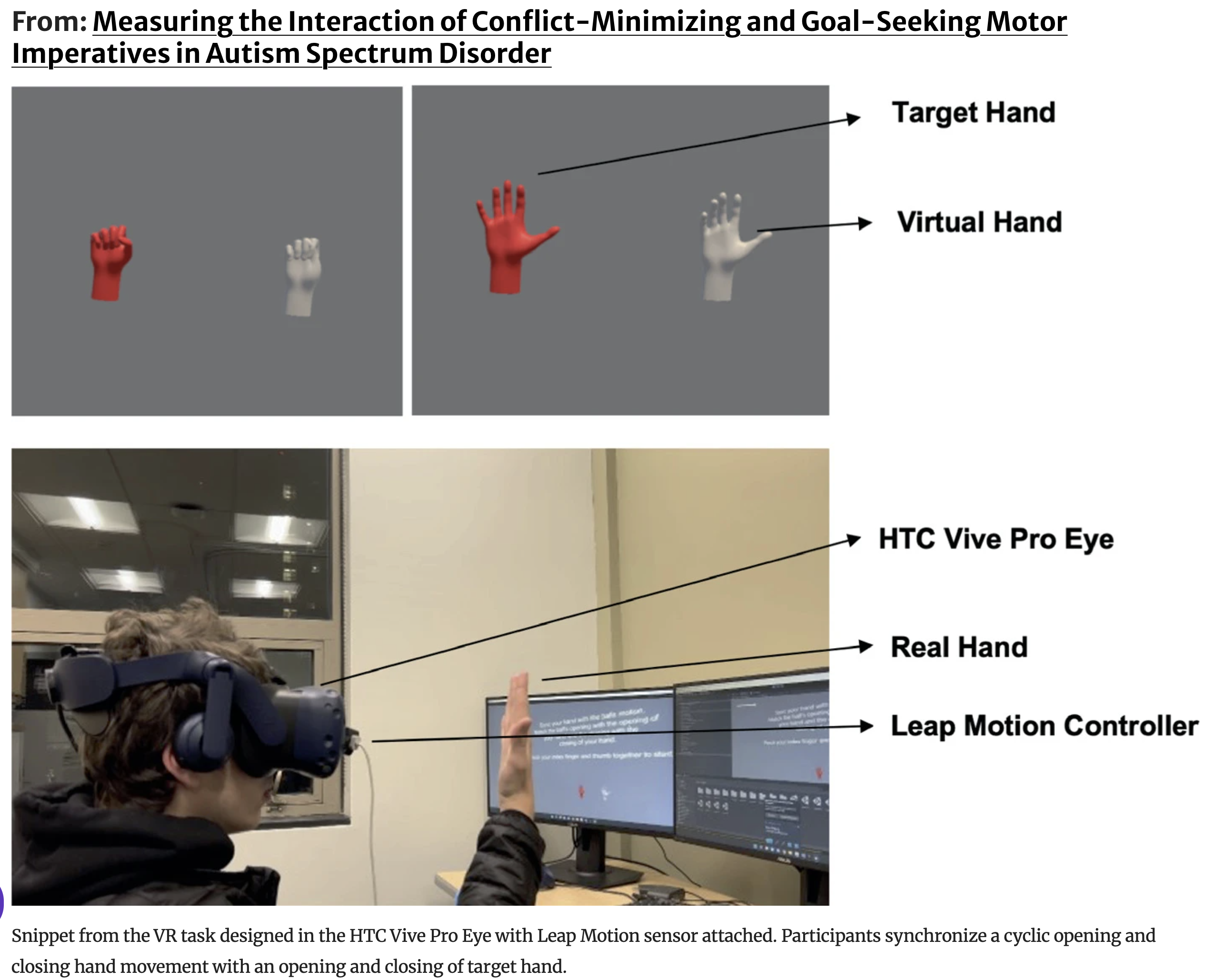
In a pilot of 11 non-autistic participants, transiently delaying the visual image of either the target hand or the participant's own virtual hand caused people to spontaneously delay their own movement, even though the instruction was simply to track the target. A Dynamic Time Warping analysis quantified this: synchronization stayed tight in control trials but showed a measurable increase in lag during the perturbation window, confirming that visual conflict alone shifts motor output without the participant intending it. The work also contributes a Kalman-filter formulation of the active-inference synchronization model, a simpler alternative to prior sinusoidal approaches, that frames the behavior in terms of how much precision a person assigns to vision versus proprioception.
Precision-weighting between vision and proprioception is the mechanism sitting underneath a cluster of problems immersive devices deal with directly: latency and registration error, discomfort, and the performance cost of an interface that asks the visual system to override what the body is reporting. This paradigm turns that into something measurable during the interaction rather than something recalled afterward on a questionnaire, and pairs it with a model that predicts which direction the effect should move as the sensory evidence changes.
The same model predicts that autistic individuals, given documented differences in sensory precision-weighting, should respond differently to these perturbations; recruitment of an autistic cohort was underway at publication. If borne out, the result would link several previously separate sensorimotor findings in autism under a single active-inference account and point to concrete targets for intervention.
How do people with Type 1 diabetes, and the clinicians and caregivers around them, actually make daily management decisions, and where could a gamified tool genuinely help rather than add burden?
End-to-end research program anchored in Northeastern's NSF i-Corps site, the National Science Foundation's lean-startup curriculum for moving research from lab to market. Following the I-Corps customer-discovery model, I ran 110+ semi-structured interviews across patients, clinicians, caregivers, and payers under weekly mentor-led coaching, testing demand and willingness-to-pay before committing to build. That discovery foundation fed a moderated, task-based usability study of the app and survey design and analysis of self-reported outcomes.
Three studies converged on a clear picture. In the ML evaluation on the OhioT1DM benchmark, a Sequence-to-Sequence BiLSTM gave the most consistent glucose forecasts across subjects (mean RMSE 21.9 mg/dL at 30 minutes), which set the prediction engine. Usability testing (7 participants) showed strong acceptance of the glucose-forecast feature (71% would use it daily) but flagged that the initial gamification display felt overwhelming. And need-finding with 6 caregivers surfaced a core tension: supporters wanted safety without surveillance, preferring "status at a glance" and gentle nudges over raw data streams.
The research directly shaped the product. The forecast findings drove a progressive-unlocking redesign of the gamification and clearer prediction explanations; the caregiver insights became an entire companion app, Sugar Slay Care, built around role-based, user-controlled data permissions rather than always-on monitoring. The work was published as a first-author paper in Frontiers in Digital Health and supported by roughly $86K in non-dilutive funding: the NSF I-Corps site that structured the discovery work above, the MassVentures Acorn Innovation Grant (a Massachusetts program backing startups that commercialize federally funded research), and the Northeastern SPARK Fund, which seeded the early prototype.
The patient app: glucose forecasting, gamified challenges, and progress tracking.
Sugar Slay Care: the companion app for caregivers, with role-based, user-controlled permissions.
Users of a diabetes app want to ask questions in their own words, and a language model can answer them. But in this domain a confident wrong answer is a clinical risk rather than a bad review. How do you constrain an assistant so that it helps without ever speaking as a clinician, and how would you actually know whether the constraint held?
Design. I specified the assistant's operating envelope in its system instructions: which sources it may draw on, what it is permitted to discuss (the app itself, general diabetes education, and the user's own logged data), and what it must decline. It does not prescribe, dose, diagnose, or advise in a clinician's voice, and it routes anything in that territory back to the user's care team. The assistant shipped to a pilot cohort under those constraints.
Evaluation. A system prompt describing the right behavior is a hypothesis, not evidence, so I designed a structured evaluation to test it. It has four parts that each exist to defeat a specific way this kind of testing usually goes wrong: a six-category failure taxonomy, so failures are named rather than collapsed into one pass rate; paraphrase sets that ask the same prohibited thing several ways, because a refusal that survives one wording and not another is not a refusal; multi-turn pressure sequences, since real users persist and single-turn testing misses that entirely; and a three-level severity rubric, so a cosmetic slip is not scored as equivalent to a dosing suggestion. Two independent raters score the transcripts, with Krippendorff's alpha reported as a check on whether the rubric is clear enough to be applied consistently rather than as the finding itself.
The assistant is deployed to the pilot cohort. The evaluation protocol is written and fixed in advance of scoring, so the scoring cannot be tuned to the results; the first scored slice is in progress. No pass rates are reported here until they exist.
Most published chatbot safety evaluations report a single pass rate against a fixed prompt list, which mostly measures the prompt list. The parts doing real work here are the ones that make the test harder than the deployment: rewording, persistence, and a severity scale that refuses to let a harmless formatting slip and a dosing suggestion count the same. The framework is product-agnostic and transfers to any assistant with a boundary it is not supposed to cross.
Across 15+ years of coaching, how does engagement and retention differ between current and past clients, and what does that tell leadership about where the program is and isn't serving people well?
Independently designed and executed a retrospective cohort study of 15+ years of private-pay LifeMAP coaching data (2008–November 2025), comparing 213 active clients (16,466 sessions) against 1,165 past clients (29,740 sessions) across 28 predefined metrics spanning engagement, goal areas, retention, living situation, geography, and payer tier. I defined the cohorts and inclusion criteria, integrated and reconciled multiple source exports, fully de-identified the data to a single Client/Profile ID, and documented every data-quality limitation up front: no session-level timestamps (so frequency measures are explicitly modeled proxies), and a gender field absent from the active export (so that breakdown is reported for the past cohort only). The deliverable was a structured report with professional visualizations written for a non-technical executive audience.
Because active clients are still in coaching, a naive comparison would have overstated their engagement. I treated this survivorship effect as a first-class methodological issue, framing every active-vs-past contrast as ongoing rather than complete and flagging it in the interpretation notes so leadership would not over-read the gap. I also called out small-sample artifacts that visually dominated certain charts (for example, a 13-client "living situation unknown" group whose ~306 average sessions was an outlier effect, not a real signal), so decisions would rest on the stable findings rather than the noise.
The active cohort was far more deeply engaged than past clients: a median of 47 sessions versus 14, and 86.85% pursuing multiple goals versus 61.55%. A retention-style curve held active clients above past rates at every interval (about 79% still engaged at ~6.5 months, against a much faster drop-off in the past cohort). Engagement was also highly concentrated: the most-engaged segment (50+ sessions) was roughly 46% of active clients but accounted for about 84% of all coaching hours. Employment, Independent Living/Self Care, and Life Skills were the dominant goal areas across both cohorts, and goal tracking had clearly improved over time, with only 1.88% of active clients lacking a recorded goal.
I designed and delivered the study end to end and presented it to both the program team and the executive team. The findings are now informing budgeting and marketing strategy for the LifeMAP program, which generates roughly 30% of the organization's revenue and underwrites many of its free and low-cost services for the autistic community. This had been a long-standing organizational priority left uncompleted because of its complexity; the engagement-concentration and retention results gave leadership a concrete, data-backed basis for where to focus retention efforts and how to position the program.